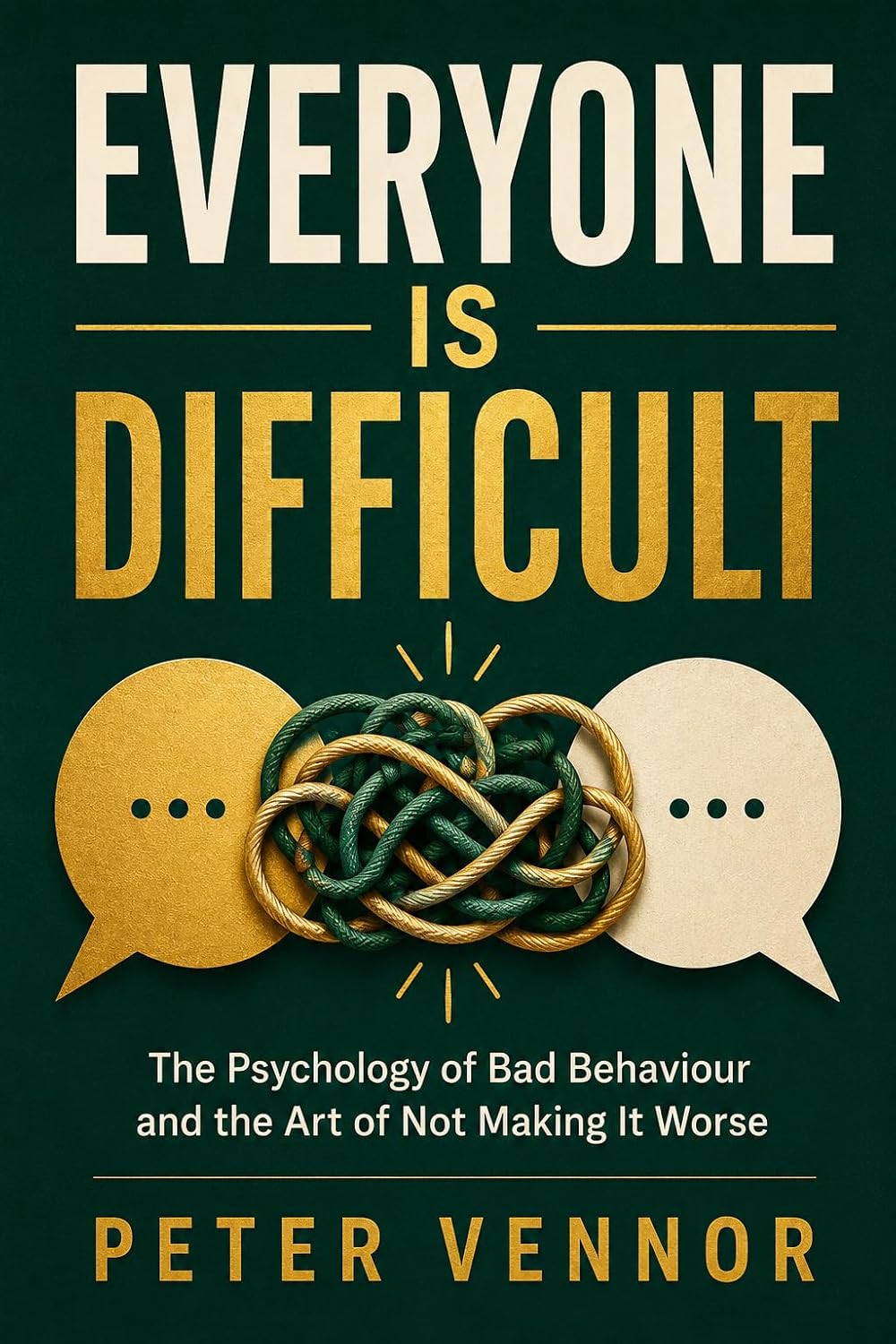
Everyone Is Difficult
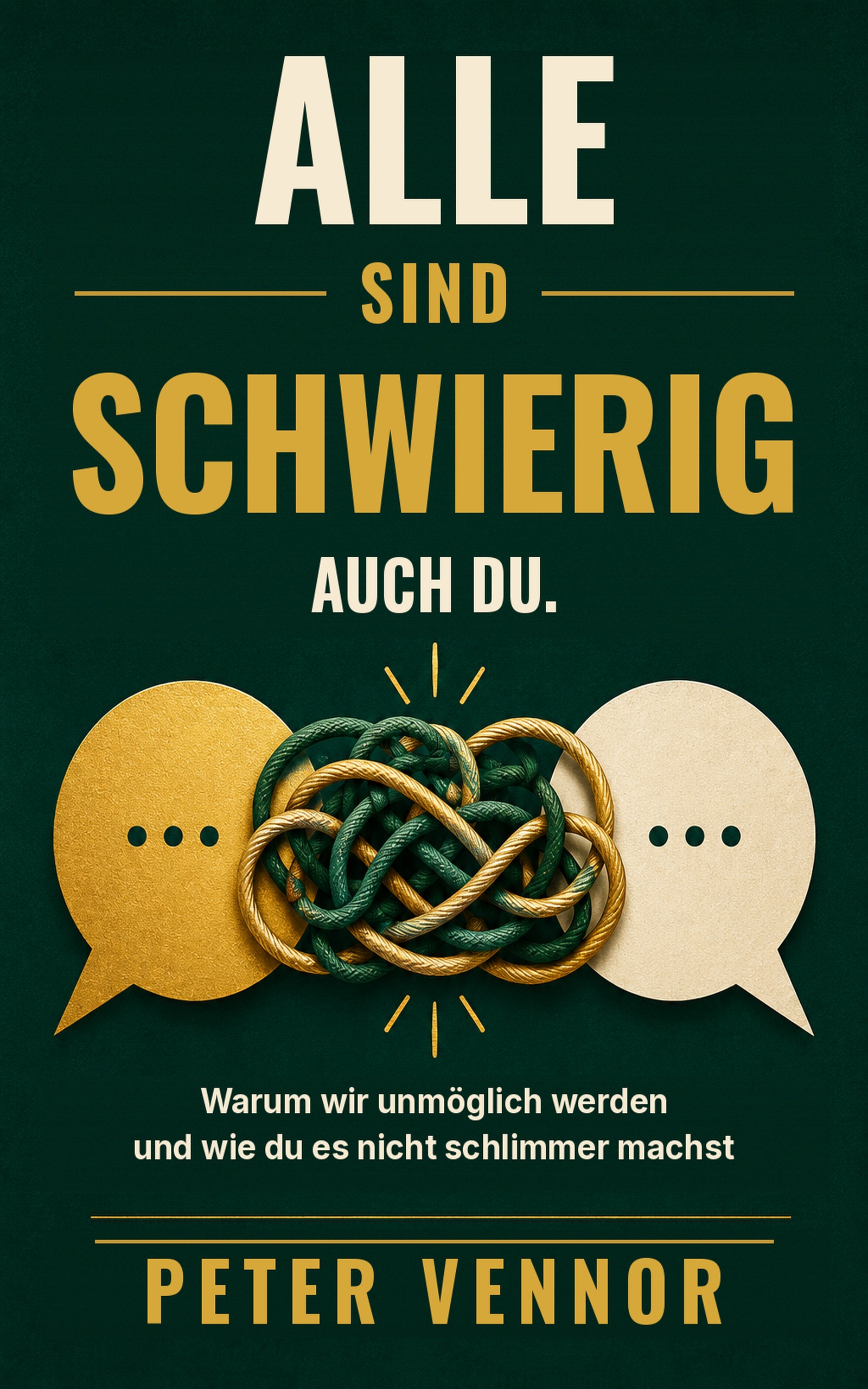
Alle sind schwierig. Auch du.
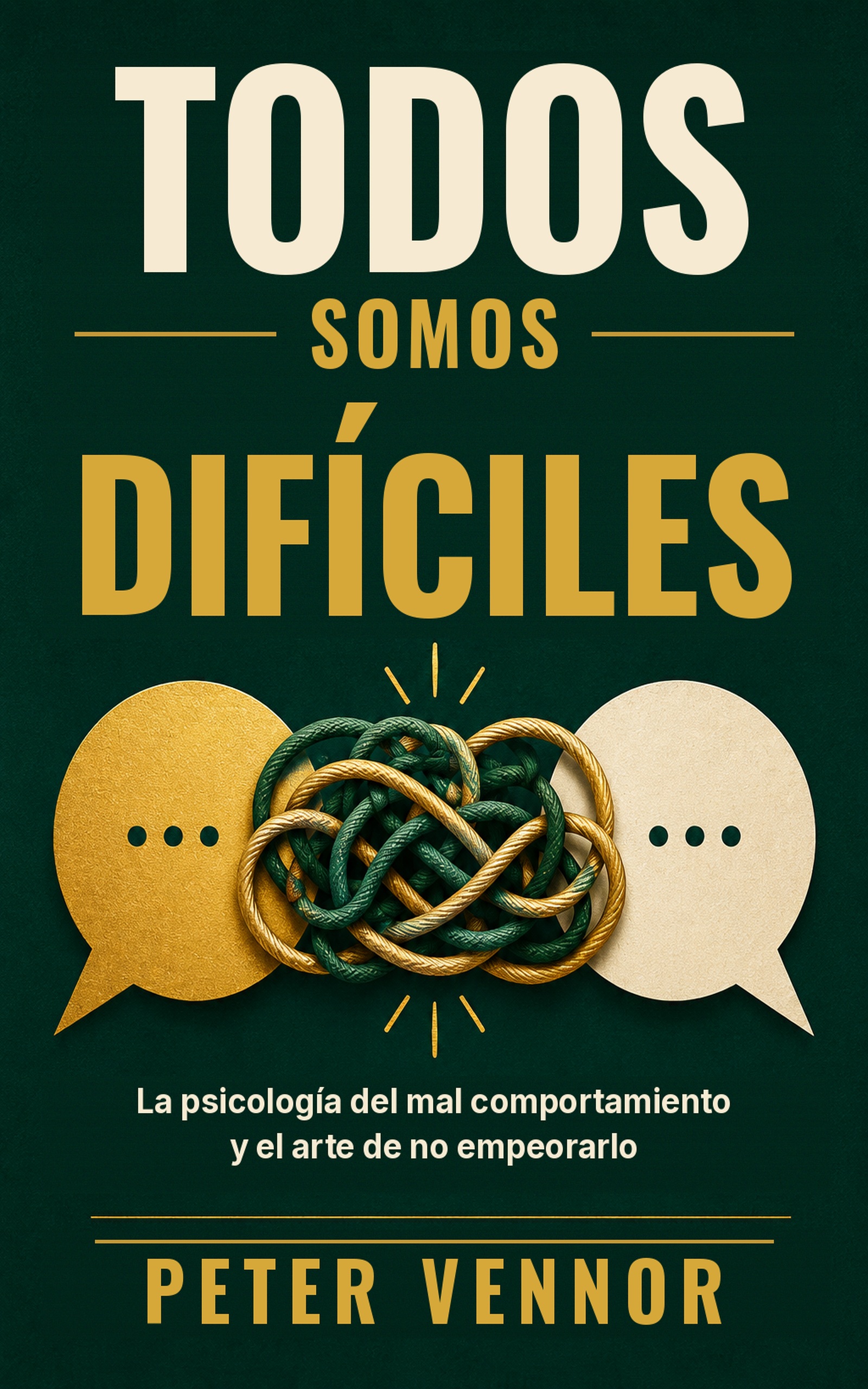
Todos somos difíciles
The short version
This is one of our own titles, not a client project, and the German edition has not been on sale long enough to prove anything about sales. What it can show is the work, which is the part you would be buying.
The record below follows the German edition, which came first. A Spanish edition has since followed, built the same way with one difference, and it has a section of its own further down. The two mistakes recorded here did not recur on it. Six new ones did, and they are written down too.
The title was the first decision, and it is not a translation
Everyone Is Difficult makes the reader work out that they are included. German has a shorter way to say it, so the German edition says it outright and the title became Alle sind schwierig. Auch du. Everyone is difficult. You too.
The obvious word for difficult is nervig, which carries the bluntness exactly. We rejected it. Nervig belongs to a flatmate who leaves the dishes out. Schwierig is the word German uses in human resources, in therapy, and in the phrase schwierige Gespräche, and it is the word a reader would type into a search box. Bluntness survives a border. Register does not, and it has to be decided again.
One consequence turned up later, in the conclusion. The English spends a paragraph arguing that the title invites a misreading. In German that misreading is not available, because the cover has already corrected it. That paragraph was rewritten rather than translated. A translator working chapter by chapter would have carried it across intact and nobody would have noticed.
One piece of artwork, three languages
The first German cover was generated on its own, from the same brief. It came back close but not the same. Measured against the English, its cream was 222,193,151 against 236,223,194, its gold was darker and more orange, and the whole cover sat thirty per cent lower in mean brightness. Side by side, one of them looked like a reprint of the other.
So the artwork is no longer regenerated. It is kept, pixel for pixel, and only the type is replaced. The background behind the new lettering is rebuilt from the cover’s own margins, row by row, so the vertical gradient and the paper grain carry through and there is no seam.
What comes out is three covers that match to within two points on every colour.
| Background | Cream | Gold | |
|---|---|---|---|
| English | 0, 34, 24 | 236, 223, 194 | 210, 159, 48 |
| German | 0, 34, 24 | 236, 221, 190 | 209, 161, 53 |
| Spanish | 1, 34, 25 | 238, 224, 195 | 209, 161, 54 |
The layout carried across on its own, which was luck rather than planning. Everyone, is, difficult is a three-beat stack, and so are Todos, somos, difíciles. German needed a fourth beat, so Auch du. sits apart, smaller, below the block and closer to the knot than to the title. That is exactly what the sentence is.
The help page was replaced, not translated
The English edition ends with a page of crisis resources. 999. Refuge. Acas. NHS 111. The Samaritans.
None of it applies in German. Translated faithfully, it would have handed a reader in Berlin a British emergency number.
So the page was rebuilt for Germany, Austria and Switzerland, because a German-language edition sells into all three. A free helpline reaches only the country that set it up. Of the numbers on that page, only 112 crosses a border, because it works across the European Union, and it is the one the page gives first. Every other number was checked against the body that issues it, on the day it was written.
One of them could not have come from memory. Switzerland introduced a national victim helpline, 142, on 1 May 2026, three months before the edition was made. It is also explicitly not an emergency number, so the page says 117 or 144 for immediate danger, which is the distinction the Swiss authorities themselves put first.
Where no equivalent exists, the page says so instead of inventing one. Germany has no Acas, so it names the Antidiskriminierungsstelle for discrimination and the works council and union inside the company.
What the checks found
Every chapter was run against the source before anyone read it, on fifteen separate mechanical checks. All eighteen chapters passed all fifteen.
Then the proofreading pass. A language model that never saw the English went through the text first, and a person after it. Between them they returned 284 corrections.
Nearly half of them, 117, were the same fault. An English idiom rendered literally into German words. The kind of thing that is invisible to anyone holding the original, because the source tells them what it was supposed to mean. That is the entire reason the first pass does not get to see it.
The remaining 167 fell into four further groups. We keep the ranking because it decides what the brief for the next book forbids by name.
The numbers
| English | German | Spanish | |
|---|---|---|---|
| Words | 65,715 | 65,386 | 73,971 |
| Characters | 385,371 | 436,805 | 442,721 |
| Characters per word | 5.86 | 6.68 | 5.99 |
| Printed pages | 184 | 202 | 260 |
| Spine width, inches | 0.414 | 0.455 | 0.586 |
| Formats produced | 5 | 5 |
Words and characters counted on 19 September 2026 from the published file of each edition, by one method, twice, with two independent counters. Body text including headings, front matter excluded. Printed pages as KDP lists them for the published edition.
Three languages, three different books by the numbers, but not in the way the usual account has it. The German edition uses almost exactly as many words as the English one, half a per cent fewer, and thirteen per cent more characters. German words are longer, not fewer. That is what adds eighteen printed pages while the word count stands still. Spanish needs thirteen per cent more words and fifteen per cent more characters. Each of those differences decides a spine width, which decides a cover.
Spine width is page count multiplied by the thickness of one sheet, and for the white stock this book prints on that is 0.002252 inches. The Spanish spine is more than forty per cent wider than the English one. A cover is drawn to one exact width, so a wider spine is a new file at new dimensions and not the same artwork scaled up. That is the part of a second edition that never appears in a quote priced by the word.
Characters are the measure here, not words. A count in words makes a complete edition look thin.
What replaced the native reader on the Spanish edition
The German edition had a native reader at the end. The Spanish one did not, and rather than quietly drop the step we replaced it with things that can be counted. Here is what they returned on the finished manuscript.
| Measured | Limit | |
|---|---|---|
| Subject pronouns | 0.27% | 1.20% |
| Possessives | 0.75% | 2.60% |
| Gerunds | 0.63% | 1.10% |
| Passive with ser | 0.03% | 0.35% |
| Length against the English | 1.12x | 1.10 to 1.30 |
Those five are the fingerprints an English source leaves on Spanish prose. Spanish drops its subject pronouns and English carries them. Spanish says la mano where English says his hand. A translation that follows the English keeps all of it, and all of it is countable. Every figure came back under a fifth of its limit.
Then the finished text went back through an independent engine into English and was set against the original paragraph by paragraph. Not one figure in the book had moved. Not a percentage, not a year, not a participant count, anywhere in the book.
That check measures the distance from the source, which is what makes it useful and also what limits it. A figure that ought to have changed, because the edition is going to a different country, passes it untouched. We know that because it happened to us, and it is in the list below.
The proofreading pass returned 1,129 interventions to a manuscript that had already cleared every mechanical check, at 16.6 per thousand words. The house band is eight to twenty. Below that the pass was too timid. Above it the pass is rewriting rather than editing.
Two mistakes, since the checks are only worth what they catch
The page count was wrong twice. One rendering engine reported 251 pages and a projection from the English suggested 214. The printer said 202. Both covers had already been built against the wrong number and both had to be made again. The published edition has 202 pages.
The contents page listed eighteen entries twice. It survived every automated check and was obvious on page three of the printed proof, which is the whole argument for reading a printed proof.
Both are now written into the process document, with their causes. That is why the Spanish edition took less time than the German. The two mistakes were waiting there for it.
Corrected on 19 September 2026
The Spanish edition went to press with British helpline numbers. The page at the back was translated instead of being researched again, so a reader in Madrid was told to call 999, and the closing line that says the list is for readers in the United Kingdom was translated along with it. Fifteen mechanical checks, the back-translation and a cold proofread all passed it, because every one of them measures the distance from the English and a faithful translation has no distance from the English. All three formats were replaced on 19 September 2026 with a page researched country by country, and the check that would have caught it is being built.
The word count in the table on this page was wrong. The German figure published here said about 51,000 words. Counted from the published file it is 65,386, which is twenty-eight per cent more, and it means the sentence this page used to carry about German saving words was wrong as well. The English and Spanish figures held to within one and a half per cent. The words and characters in the table above were recounted on 19 September 2026, by one method, applied to all three editions. The Spanish page count went from 258 to 260 when the edition was reset.
Corrected again on 6 October 2026. On 19 September the English and German page counts were also changed, from 184 and 202 to 186 and 204, based on a retailer listing. Both had been right. KDP lists the published editions at 184 and 202, and the table says so again.
The direction is not fixed
This record runs from English into German because our own titles come out in English. That is a fact about our catalogue, not about the process. No step in it assumes English as the source.
The title is decided for the target market rather than derived from the original. The help page is researched for the destination country rather than translated from the source. And the measuring is always done against the target language. On a Spanish text we count subject pronouns, possessives and gerunds. On a German one we count nominal constructions, sentence length and idioms carried over word for word. Both sets are the fingerprints a foreign source leaves behind, and neither of them cares which source it was.
One figure does depend on the pair, and that is the length ratio. In our own measurements Spanish has needed thirteen per cent more words than English, while German has needed the same number of words and thirteen per cent more characters. The band that counts is the one fixed on your calibration sample, before the rest of the book is translated, which is also the step where a new direction either holds up or does not.
A book published in German, going into Spanish, takes the same route through the same six approvals listed above. So is English out of either.
What the author would have approved
On a client project there are six approvals, and this book passed the same gates internally. Briefing and direction. Title and subtitle from three options. A three-chapter calibration sample. The cover. The back cover copy. The final proof.
Where an author does not read the target language, each of those arrives with a back-translation, because approving text you cannot read is worse than not approving it at all. The middle chapters are not sent for approval. They are checked against the source by script and read cold by a language model that has never seen the original.
That is one book in three languages. The English was written. The other two were produced with that process document already open, and both went faster for it. If you have a book that already sells, the same process is on the Localisation page, with what it costs and when we would tell you not to bother.